
Elmore Projected Versus Actual
A projected release date is a current calculation. It is not a promise that the person will walk out on that date. For Alabama state prisoners, ADOC's public terminology is "Minimum Release Date," defined as the earliest scheduled date an inmate can be released to probation or end of sentence. ADOC also states that the date can change when good time is taken away through disciplinaries or when the circuit clerk sends new cases or sentence changes.
Actual release is the custody event. It may follow a minimum release date, parole grant, mandatory release date, court order, sentence completion, bond action, or transfer decision. For Elmore County Jail, the release date may be controlled by a judge, bond, local sentence, hold, or transfer. For Elmore Correctional Facility, Staton, Tutwiler, Frank Lee, or another ADOC facility, the release calculation is tied to ADOC sentence data and may involve ABPP supervision.
Lookup Elmore Release Dates
The right lookup source follows the custodian. Elmore County has both a county jail and several ADOC facilities, so the same county name can point to different record systems. Use the person’s current or last known custody location before choosing a portal.
- For Elmore County Jail, call the jail and check Elmore court records for bond, sentence, dismissal, probation, hold, or transfer orders.
- For a sentenced state prisoner, search ADOC's inmate search while the person may still be incarcerated.
- Use AIS number when available. If searching by name, compare commit county, case number, facility, sex, race, and other identifiers.
- Read the ADOC minimum release date separately from parole consideration date and parole status.
- Check ABPP if the release may involve parole, mandatory release, probation, or supervision in Elmore County.
- Register or check VINE Inmate Check notifications for covered custody changes.
- If the person has already left ADOC search, use ADOC records, ABPP, VNS, court records, or registries where applicable.
ADOC Minimum Release Fields
The ADOC definitions page supplies the field labels that matter for an Elmore County release date lookup. These fields work together. A single date may depend on the sentence, county jail credit, good-time status, and whether sentences run together or one after another.
| ADOC Field | Release-Date Role |
|---|---|
| Minimum Release Date | Earliest scheduled release to probation or end of sentence. |
| Jail Credit | Time spent in county jail before sentencing, prepared by the circuit clerk. |
| Good Time Received | Credit awarded that can move the minimum date earlier for eligible inmates. |
| Good Time Revoked | Credit removed after discipline, which can move the date later. |
| Parole Consideration Date | A tentative board consideration marker, not a release date. |
| Parole Status | Shows parole status terms such as active, delinquent, or revoked when applicable. |
| Commit County and Case Number | Bridge the prison record to the sentencing court record. |
Alabama Good-Time Calculation
Alabama correctional incentive time is governed by Alabama Code Section 14-9-41. The statute includes sentence-computation rules and exclusions. Consecutive sentences are combined for deduction and release-date computation. Concurrent sentences use the sentence that results in the longer period of incarceration. That means the sentence structure can change the release date even before good-time credits are considered.
The same statute excludes categories of cases from correctional incentive time, including Class A felony convictions, certain deadly-weapon death cases, life or death sentences, sentences longer than 15 years, and child sex offenses. Because exclusions are case-specific, Elmore County release date copy should not use a simple calculator model. Two people with similar total terms may have different eligibility, credit, and minimum release dates.
Jail credit is a separate source of movement. ADOC defines jail credit as time spent in county jail before sentencing, and the sentencing circuit clerk prepares it. If a person spent time in Elmore County Jail before being sentenced to ADOC, a credit issue may need the court or circuit clerk as well as ADOC.
Why Elmore Release Dates Move
Release-date movement is common enough that the date should be rechecked before making plans. Some changes come from prison discipline, some from court records, and some from supervision decisions.
| Cause | Effect On Release Date |
|---|---|
| Good-time revocation | Can move an ADOC minimum release date later. |
| New case or sentence correction | Can change the controlling term after the circuit clerk sends updates. |
| Jail-credit correction | Can move the date earlier or later depending on the corrected credit. |
| Detainer or hold | May prevent community release even after one custodian stops holding the person. |
| Parole grant | Starts home-plan and ADOC coordination before actual release. |
| Parole denial or reset | Means no parole release from that hearing and possible future consideration. |
| Mandatory release | May place eligible ADOC inmates on supervision before end of sentence. |
Elmore Parole Date Limits
Parole consideration is not the same as a projected release date. ABPP says parole eligibility is calculated under Alabama Code Section 15-22-28, using sentence, offense, jail credit, good-time eligibility, time served, and court orders. The one-third-of-sentence or 10-year rule applies to many prisoners, while listed serious offenses have stricter timing. A set date does not guarantee a hearing during that month.
Mandatory release is separate again. ABPP describes mandatory release under Section 15-22-26.2 for eligible cases with sentence-length windows before end of sentence. ADOC determines the mandatory release date and coordinates with ABPP. For Elmore County supervision, the Wetumpka Field Office may become relevant after state release.
A parole grant also is not the same as physical release. ABPP's FAQ explains that once parole is granted, the agency must verify the home plan and coordinate with ADOC before scheduling release. A parole result page can show board action, while ADOC and ABPP coordination determines the actual departure from custody. A denied-with-reset result is a future consideration marker, not a release date.
ADOC Date Definitions
ADOC's definitions page is the source for Alabama release-date field labels: review ADOC definitions.
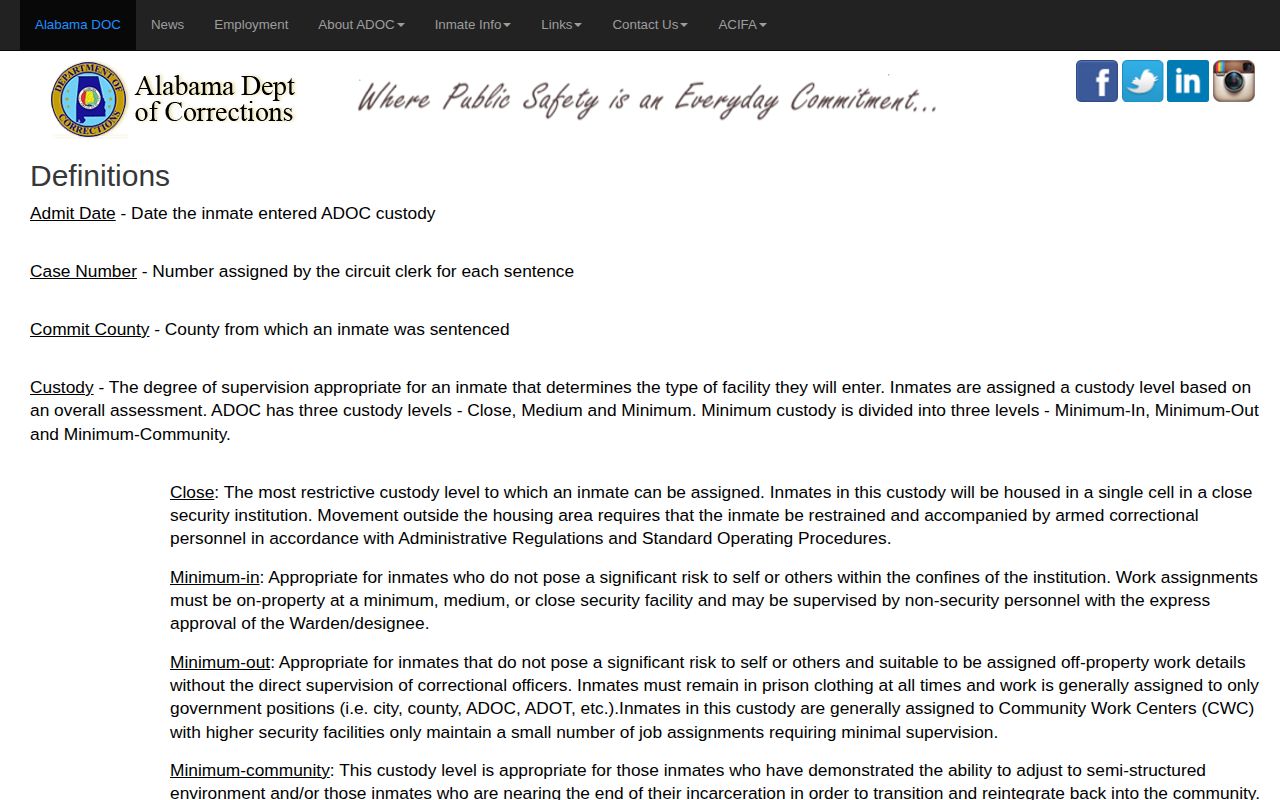
The definitions are especially important in Elmore County because a person may move from the county jail to an ADOC facility, and the state release-date fields then replace local jail timing.
Elmore Jail Date Limits
A county jail detainee usually does not have an ADOC minimum release date. Pretrial release depends on bond, court orders, holds, and whether a judge must approve conditions. A short county or municipal sentence depends on the commitment, jail credit, time served, and any release processing by the jail. A transfer to ADOC changes the source system.
When the person is in Elmore County Jail, call the jail and check Elmore court records. When the person is in Elmore Correctional Facility, Staton, Tutwiler, Frank Lee, or another ADOC facility, use ADOC minimum release date and ABPP parole or mandatory-release sources. After ADOC release, use ADOC records, ABPP, VNS, and court records.
The sheriff FAQ's failure-to-appear and failure-to-pay explanation shows why local release timing can be court-driven. A person may need to appear before a judge or satisfy court-set conditions before release. In that setting, no public date calculator can give the answer. The court order, jail custody status, and release record must be read together.
Elmore Sentence Type Matters
Sentence type changes the release-date source. A pretrial detainee is waiting on bond, court action, dismissal, plea, trial, transfer, or hold resolution. A county jail sentence is controlled by the local commitment and jail processing. A state sentence is controlled by ADOC sentence data, jail credit, good time, and any parole or mandatory-release rules. A federal sentence belongs to BOP, not ADOC or the sheriff.
For Elmore County, do not collapse these paths. A person booked into the county jail may later receive ADOC jail credit, but the credit comes from the sentencing clerk and is applied in the state system. A person housed in an ADOC facility in Elmore County is not on the county jail's 24-hour release list. A person released to ABPP supervision may no longer appear in a custody search but still have active reporting duties.
Confirm Elmore Release Dates
When an exact date is important, use records rather than a single online clue. ADOC's public search can identify a current state prisoner and show release-related fields while the person remains searchable. After release, ADOC records, ABPP supervision records, VNS notices, and the sentencing court become more useful. For the county jail, the sheriff records request and Elmore court docket are the better confirmation sources.
Ask for the narrow record that answers the date question. For jail records, request the booking sheet, release date and time, release type or reason, and transfer destination if any. For ADOC, include AIS number, name, date of birth if known, commit county, case number, facility, release date, release type, and supervision handoff if public.