
Releases from Frank Lee
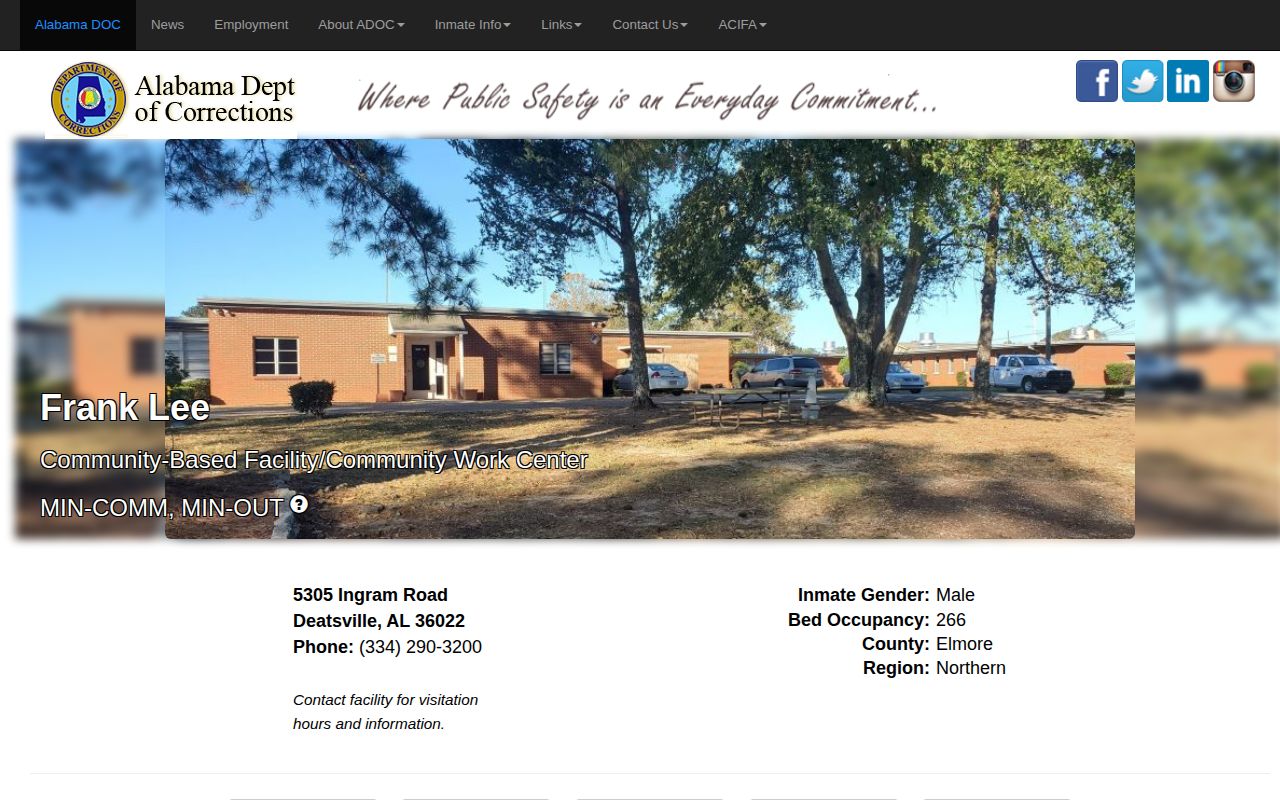
ADOC lists Frank Lee Community-Based Facility / Community Work Center at 5305 Ingram Road, Deatsville, AL 36022, with phone 334-290-3200. It is in Elmore County and ADOC describes it as opened in 1964 as a camp for first-time offenders. The research also notes its connection to nearby J.F. Ingram programs.
The important release distinction is community custody versus final release. A person at Frank Lee may have more community-facing custody conditions than someone in a traditional prison, but that does not mean the sentence has ended. Leaving Frank Lee can mean discharge, parole, mandatory release, transfer, community placement change, or another ADOC movement. The release reason controls the next search.
How to Confirm a Frank Lee Release
Use ADOC first while the person may still be in state custody. ADOC's public search contains current inmates only, so a released person may not remain visible online after discharge. A missing result should be followed by records, supervision, notification, and court checks.
- Search ADOC by AIS number, or by name if the AIS is not known.
- Compare facility, custody, commit county, case number, sentence date, offense, minimum release date, and parole consideration date.
- Ask whether the person was discharged, transferred, paroled, released to mandatory supervision, or moved to another ADOC placement.
- Use ADOC public records for a written release or discharge confirmation after the person leaves current custody.
- Use ABPP Wetumpka Field Office if the person reports in Elmore County after release.
- Check the sentencing court for jail credit, sentence orders, probation, split sentence, revocation, or expungement activity.
The Elmore County released inmate search should keep Frank Lee separate from the sheriff's jail. A county jail release is local custody. Frank Lee is state custody under ADOC.
Frank Lee Records and Contact
Facility: Frank Lee Community-Based Facility / Community Work Center
Agency: Alabama Department of Corrections
Address: 5305 Ingram Road, Deatsville, AL 36022
Phone: 334-290-3200
Records route: ADOC Public Records Coordinator, public.records@doc.alabama.gov, 334-353-3883
For an ADOC release record, provide AIS number, full name, date of birth if known, commit county, case number, Frank Lee facility reference, approximate release or transfer date, and whether the request concerns discharge, parole, mandatory release, or transfer. ADOC's current public-record request form identifies a non-refundable $20 processing fee.
About Frank Lee Community-Based Facility
Frank Lee's community-based identity makes it easy to overstate release. The safer wording is that it is an ADOC state facility with community work-center features. A person can be in community custody and still be under ADOC authority. Work assignment, lower custody, or community placement should not be described as release unless the record shows discharge or supervision handoff.
The ADOC Frank Lee Community-Based Facility page is the source shown below, and it helps separate work-center custody from final release.
ABPP After Frank Lee
If Frank Lee release results in parole, probation, or mandatory release in Elmore County, the Wetumpka Field Office is the local ABPP office. It is in Room 173 of the Elmore County Judicial Building, 8935 U.S. Highway 231, Wetumpka, AL 36092, with phone 334-567-4367. ABPP records can help confirm local reporting and supervision conditions, while the sentencing court explains the sentence itself.
A parole grant, mandatory-release date, and physical release date are not the same thing. ABPP verifies home plans and coordinates with ADOC, and ADOC determines mandatory release for eligible cases. Do not treat an expected date as final without checking the current status.
Transfer Is Not Release
Frank Lee, Staton, and Elmore Correctional Facility can appear together in one state-custody history. If the record says the person moved from Frank Lee to another ADOC facility, the person remains in state custody unless a later discharge or supervision record says otherwise. Alabama VNS notifications, ADOC records, and court case records are the proper confirmation sources after the online current-only search stops showing the person.
Community Custody Records
Frank Lee's community-based role can create confusing language in family notes, employer paperwork, and court discussions. A person may have a work assignment, community work-center placement, or less restrictive custody level without being legally released from ADOC. The release record should answer a precise question: did ADOC stop holding the person on that sentence, did ABPP begin supervising the person, or did the person simply move to another custody setting?
When checking a Frank Lee record, preserve the difference between facility placement, custody level, transfer, discharge, parole, and mandatory release. If the person is still in ADOC, the current search may show facility and release-date fields. If the person has left ADOC custody, a public-record request can ask for release date, release type, and supervision handoff if public. The court case remains important because jail credit, sentence structure, and later court orders can change the release calculation.
Frank Lee Proof Chain
A good proof chain for Frank Lee starts with the ADOC record and ends with the system that explains the next status. If ADOC shows current custody, the record is not a release. If ADOC shows a different facility, the event is probably transfer. If ADOC records confirm discharge, then the court record and any ABPP supervision should be checked for the legal result after custody. If ABPP confirms active reporting, that answers the supervision question but does not replace the release record.
For Elmore County readers, the central distinction is still custodian. The sheriff's jail confirms local bookings and county release events. ADOC confirms state custody and release from Frank Lee. ABPP confirms supervision. The court confirms sentence and case outcome. Mixing those records can make a transfer look like a release or a supervision condition look like a new booking.
Final Frank Lee Check
Close a Frank Lee search only after the next status is identified. The answer may be discharge from ADOC, parole or mandatory release to ABPP, transfer to another ADOC facility, or continued state custody in a different placement. Each outcome uses a different confirmation source and should be named precisely in notes or requests.
Public Record Search
Sponsored Results